
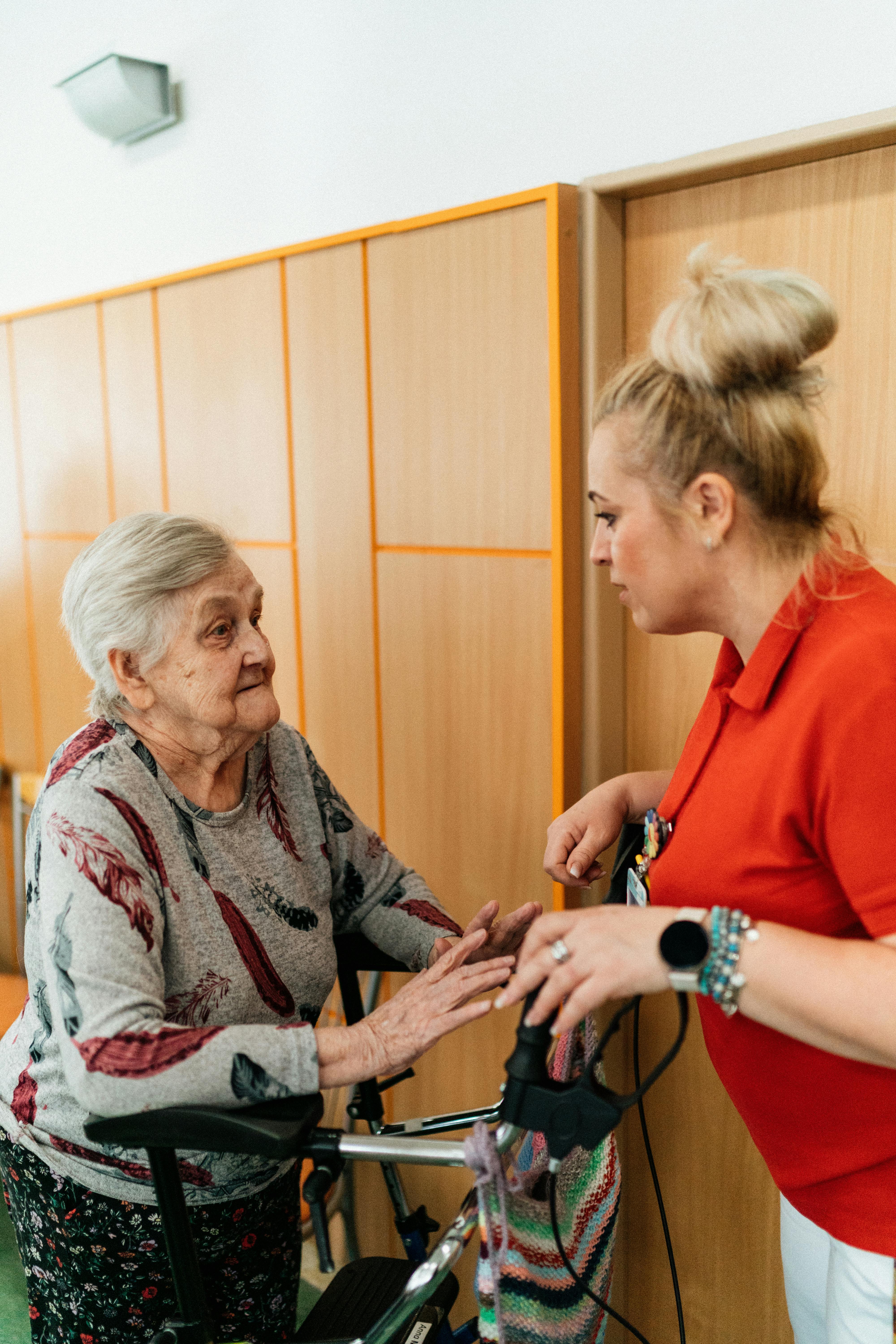
For most families, choosing a home care agency is already stressful. For the roughly one in three Houston seniors who don't primarily speak English, it's also a language problem — and language problems in healthcare have real consequences. A caregiver who can't fully understand a patient's pain description, medication history, or daily needs creates risk, not just inconvenience.
The 2024 American Community Survey, published by the U.S. Census Bureau, gives us the clearest picture yet of who Houston's 65-and-older population actually is. The numbers are worth understanding before you call a single agency.
The full picture: Houston seniors by language
Houston's 65-plus population is approaching 290,000 — one of the most linguistically diverse senior populations in the United States. Of those, roughly 35% speak a language other than English at home.
| Language | Seniors 65+ | Share | Limited English proficiency |
|---|---|---|---|
| English only | 187,306 | 65.3% | — |
| Spanish | 68,453 | 23.9% | ~45% (≈ 31,100 people) |
| Vietnamese | 8,454 | 2.9% | ~60% |
| Chinese (incl. Cantonese) | 4,127 | 1.4% | ~55% |
| Other Indo-European | 10,193 | 3.6% | Varies |
| Tagalog | 1,521 | 0.5% | Low |
| Arabic | 1,410 | 0.5% | Moderate |
| African languages & other | 4,897 | 1.9% | Varies |
Source: U.S. Census Bureau, 2024 American Community Survey (ACS), Table B16004 — Houston city, TX. Estimates; margins of error apply.
Spanish-speaking seniors: the largest non-English group by far
Nearly 1 in 4 Houston seniors (68,453 people, 23.9%) speak Spanish at home. Of those, roughly 31,100 — about 45% — have limited English proficiency, meaning English isn't their working language for medical conversations.
Geographically, Spanish-speaking seniors are most concentrated in East Houston and Northside: the 77011, 77020, and 77076 zip codes have some of the city's highest densities of Spanish-dominant elderly households. But the community is spread across a wide area, from southwest Houston to the near north side.
For families in these neighborhoods, the question to ask any agency isn't “do you have Spanish-speaking caregivers?” — virtually every Houston agency will say yes. The right question is: “Is the specifically assigned caregiver fluent in conversational Spanish — not a backup, not a supervisor, the person who will be in the house every day?” Intake staff and field caregivers are often different people, and the answer can change.
Browse Houston agencies with Spanish-speaking caregivers →
Vietnamese-speaking seniors: Houston's largest Asian elderly group
This surprises many families outside the community: Vietnamese is the most widely spoken Asian language among Houston's elderly, with 8,454 seniors (2.9%) speaking it at home. That is more than double the number of Chinese-speaking seniors in the same age group.
The geography explains it. Houston's southwest corridor — Sharpstown, Alief, Bellaire — contains one of the largest Vietnamese-American communities in the United States, centered around the stretch of Bellaire Boulevard often called Little Saigon. This community has deep roots: families who arrived in the late 1970s are now in their 70s and 80s; their parents are in their 90s. The demand for Vietnamese-speaking home care in southwest Houston is real and sustained.
Approximately 60% of Houston's Vietnamese-speaking seniors have limited English proficiency — the highest LEP rate of any language group in the data. For these families, language match is not a preference. It's a clinical necessity.
Browse Houston agencies with Vietnamese-speaking caregivers →
Chinese-speaking seniors: Mandarin and Cantonese are not the same
An estimated 4,127 seniors (1.4%) speak Chinese at home, including both Mandarin and Cantonese. About 55% have limited English proficiency. Chinese-speaking seniors cluster in the southwest — Sharpstown, the Chinatown area west of Loop 610 on Bellaire, and the Medical Center corridor.
A practical note most agencies won't volunteer: Cantonese and Mandarin are not mutually intelligible in conversation. They share a writing system but sound entirely different spoken aloud. If your parent speaks Cantonese, a Mandarin-fluent caregiver may not communicate effectively with them day-to-day. Always confirm the specific dialect — not just “Chinese” — with any agency before committing.
Browse Houston agencies with Chinese-speaking caregivers →
Other language communities
The 2024 ACS also documents smaller but meaningful senior populations speaking Russian or Polish (1,850), Arabic (1,410), French or Haitian Creole (2,012), Tagalog (1,521), and a range of African languages including Swahili and Yoruba (2,447 total).
Tagalog-speaking seniors tend to have relatively high English fluency and often have more flexibility in agency choice. Arabic-speaking seniors — concentrated in parts of southwest Houston and Sugar Land — face moderate language barriers; fewer agencies in Harris County have Arabic-fluent caregivers on staff, so lead time for matching is longer.
Why language match matters beyond comfort
There is a research basis for this that goes beyond patient preference. Studies published in peer-reviewed journals including Health Affairs and the Journal of General Internal Medicine consistently show that elderly patients with limited English proficiency who receive care in their primary language report:
- Better caregiver communication and clearer instruction comprehension
- Higher medication adherence
- Fewer preventable adverse events and emergency department visits
- Higher satisfaction with care decisions
For elderly patients managing multiple chronic conditions — hypertension, diabetes, heart failure, post-stroke recovery — these are not marginal differences. The ability to accurately describe pain, understand medication timing, or signal distress to a caregiver is directly tied to whether that caregiver speaks the patient's language.
How to use this when choosing an agency
Whether your family speaks Spanish, Vietnamese, Chinese, or another language, the process for vetting agencies on this dimension is the same:
- Filter by language first, then by clinical rating. Start with the subset of agencies that have caregivers speaking your parent's language, then sort by CMS clinical stars and Google reviews within that group. A 5-star agency whose caregivers can't communicate with your parent is not a 5-star fit for your family.
- Ask about the specific assigned caregiver, not the roster. “We have Spanish-speaking staff” is not the same as “your assigned caregiver speaks Spanish.” Get a name and a direct language confirmation before the first visit.
- Confirm intake staff too. The person who answers the phone, does the intake assessment, and handles care plan changes should also be able to communicate in your language. Many Houston agencies have multilingual field staff but English-only administrative teams.
- Ask about backup coverage. If the regular caregiver is sick, who covers? Is that person also language-matched? Gaps in backup coverage are where language problems most often surface.
- For Chinese-speaking families: specify the dialect. Ask explicitly: Mandarin, Cantonese, or Hokkien (Taiwanese). Do not accept “Chinese” as a sufficient answer.
Where to start
WeCarely lists every Medicare-certified and state-licensed home care agency in Houston, filterable by the language your family needs. Every language filter links directly to agencies that have self-reported caregivers fluent in that language — ranked by CMS clinical stars and Google reviews, not by who paid us.
- Houston agencies — Spanish-speaking caregivers
- Houston agencies — Vietnamese-speaking caregivers
- Houston agencies — Chinese-speaking caregivers
- Full Houston directory — all agencies
Sources. U.S. Census Bureau, 2024 American Community Survey 1-Year Estimates, Table B16004 (Language Spoken at Home by Ability to Speak English for the Population 5 Years and Over — Houston city, TX). LEP percentages are ACS estimates; margins of error apply. Clinical research references: Wilson et al., Health Affairs (2005); Lindholm et al., Journal of General Internal Medicine (2012).